
Deutsche Umschlaggesellschaft Schiene-Straße (DUSS) mbH / Kombiverkehr Deutsche Gesellschaft für kombinierten Güterverkehr mbH & Co. KG
Individual Software
Project description
KiBa – AI and Discrete Loading Optimization Models for Increasing Utilization in Combined Transport
Compared to maritime combined transport (CT) with sea containers, continental transport features a much greater variety of loading unit types with diverse dimensions and weights. At the same time, there are many different types of railway wagons with specific loading characteristics. The major challenge in combined transport transshipment terminals, when transferring between rail and road, lies in matching each loading unit with the appropriate railway wagon. Important factors include not only the length of the loading unit but also its design, height, weight, and type of cargo.
The goal of the project is to solve this matching problem using IT and to optimize it with appropriate calculation methods and artificial intelligence (AI) techniques. The aim is to ensure that each request for loading a unit receives a prompt suggestion for optimal placement on a deployed train composition. However, this decision must be made before all information is available about which additional loading units will arrive at the CT terminal for the same origin/destination routes over time.
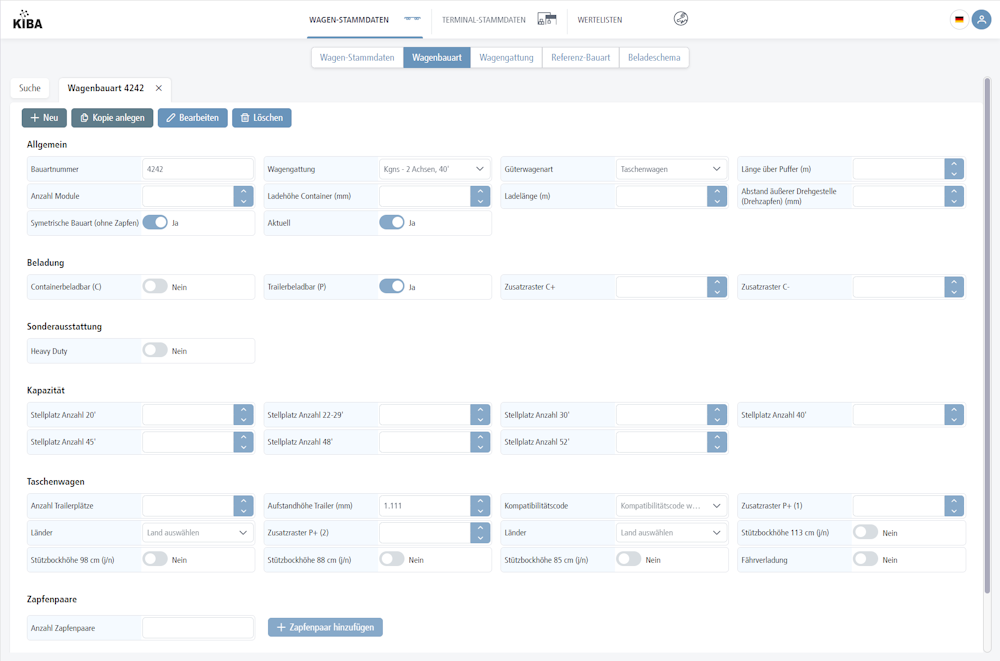
To achieve this goal, a shared master database was established for all project partners. This database includes train car master data, such as type and category, as well as possible loading schemes. The application provides a user interface for searching and maintaining the master data and offers technical access for other systems via a REST API. The frontend of the application is implemented in Angular, while the backend is developed with Spring Boot. Additionally, authentication via OAuth2 (OIDC) was implemented using Keycloak and configured in both the frontend and backend with Spring Security.
Numerous technologies such as Java, Spring Boot (Spring Core, Spring MVC, Spring Data/JPA, Spring Security, Spring Modulith), Javascript, Angular (Signals, Signal-Store, swagger-codegen, Standalone Components), Hibernate, Junit, Flyway, REST API, OpenAPI + Swagger-UI, QueryDSL, Node, npm, Maven, PostgreSQL, Sonar Qube, Gitlab inkl. CI/CD Pipelines, Docker, Nexus, Keycloak, IntelliJ IDEA, Jira and Confluence were used in the implementation of the project.
Since then, our employees maintain the data via a user-friendly web interface, while connected systems access it via a REST API. This laid the groundwork for achieving a higher level of automation across our operational systems.
Through close collaboration, the COMINTO project team thoroughly familiarized themselves with our specialized domain, ensuring that requirement gaps were identified before actual implementation even began. That is precisely why we commissioned COMINTO with the project, and we would gladly work with them again at any time.
Project details
Customer DUSS / Kombiverkehr
Category Individual Software